The situation
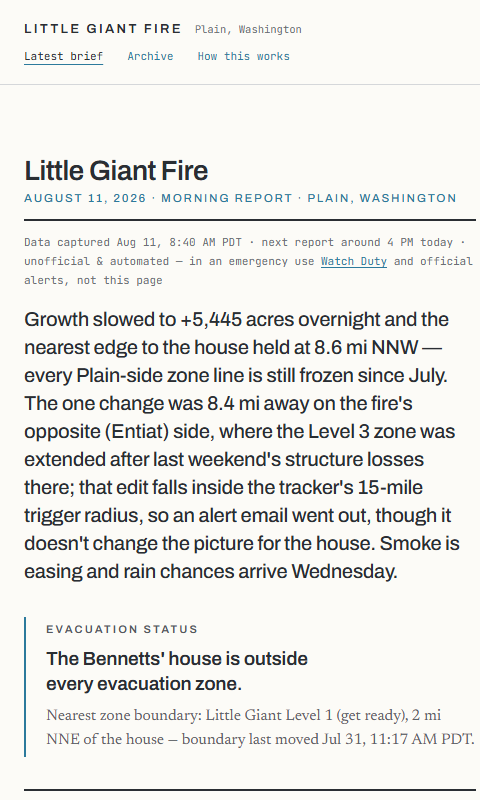
The week I published this site, the Little Giant Fire was burning nine miles from our house in Plain, Washington. I had been assembling a daily fire brief by hand with Claude in a separate session — useful, but manual.
Meanwhile, everything I had read about Anthropic's newest model, Fable, said its particular strength is long-horizon work in a single turn: holding a large, multi-step job together from one prompt instead of being walked through it. That claim is easy to repeat and hard to verify secondhand. I had a real project, with real stakes, sitting right there. So I tested it.
The idea
Write one prompt containing the entire job, and see how far a single turn gets. The prompt asked for:
- An entirely new, unlisted section of this site, built from scratch in the site's existing design system — a twice-daily brief on the fire and what it means for our house.
- A spec from my other Claude session as raw material, explicitly advisory — the architecture decisions were Fable's to make.
- A built-in adversarial review: after building, spawn a second agent with no knowledge of the instructions, have it critique the result, and revise before shipping.
- Then, only after the section was live, an automated process to update it at 8 AM and 4 PM every day.
What one turn produced
The section deployed at the end of that first turn, and it was not a demo. It is live at /littlegiant:
- A zero-dependency data pipeline that pulls the county sheriff's evacuation-zone polygons, federal fire perimeters, satellite heat detections, fire weather, and air quality — and computes every distance and bearing from our house, including whether the house sits inside any evacuation zone. That answer prints on the page every run, even when it is no.
- A schematic situation map drawn entirely in code — zones, perimeter, heat detections, distance rings from the house, the routes out.
- A written brief with a permanent archive and a methodology page explaining every source and rule.
- The review loop I required: the fresh-eyes agent came back with sixteen findings — from a map crop that cut off the day's actual fire growth to the evacuation status sitting below the fold — and the fixes shipped inside the same turn.
Then the routine
The second half of the request was standing infrastructure, built after the page was live. Twice a day, on Anthropic's scheduler, a fresh cloud agent:
- Clones the repository — every snapshot, brief, and rule lives in git, so no machine is special and my desktop plays no part.
- Runs the pipeline — deterministic code, not AI — to fetch and compute a new snapshot.
- Writes the brief under a committed runbook: third person, distances to one decimal, satellite heat is never called "fire," news never overrides GIS geometry, bad news never softened.
- Checks an alert rule — any zone change near Plain, or the house entering a zone, emails me immediately.
- Publishes through a guarded script that stages only the tracker's own files and aborts otherwise. The rest of this site — the site you are reading — cannot be touched by the automation, by construction.
Where the thesis bent
The build was genuinely one turn. The automation needed me three times: GitHub authentication, a cloud network-permissions screen, and a restart. All credentials and configuration, none of it code — which is roughly where the line between agent and human should sit.
And the next morning supplied the honest ending. The first scheduled run failed: the cloud sandbox's network policy blocked every data source. The first successful run then over-alerted, emailing me about a zone change the previous brief had already covered. I pasted the failed run's transcript back into the session; both fixes were diagnosed, made, and verified within the hour, and the morning brief published on the retry. The routine has run on its own since.
What I would tell another CMO
The one-turn claim held up better than I expected — and the turn is not the point. What makes the system usable is that it was designed to fail safely: when anything breaks, it publishes nothing, says so on the page, and leaves a transcript a human can act on in minutes. Ask your teams not just what their AI can produce, but also what happens when it breaks. That answer is where the fluency shows.